Samorith is
Fast Chemical Strengthening
From up to 24 hours to approximately 10–30 minutes
ReViSalt has developed a new process for accelerated chemical strengthening of glass. By optimising the ion-exchange process, significantly shorter processing times can be achieved compared with conventional chemical strengthening. Samorith combines the advantages of thermal and chemical strengthening.
Innovation: Samorith
Samorith is ReViSalt’s technology for the chemical speed strengthening of glass. For the first time, it enables the advantages of strengthened glass to be used across almost all glass products. Glass can be made thinner, lighter, more break-resistant and more scratch-resistant. This reduces material consumption, extends product lifetime and helps conserve resources and the environment. Lower material usage can also support faster and more efficient production.
- fast process times of 5 to 30 minutes, comparable to thermal toughening
- suitable for thin-walled glass, as known from conventional chemical strengthening
- suitable for mass-market glass products, as known from thermal toughening
- adjustable strength levels between thermal toughening and beyond conventional chemical strengthening
- adaptable to different glass products and performance requirements
State of the art for strengthening glass
Chemical strengthening (CV)
Well-known chemical strengthening processes require – depending on the glass system – up to 24 hours for the ion exchange. The advantages of glasses strengthened in this way are outstanding. Due to the high level of effort involved, this technology is only suitable for expensive special products or small parts such as mobile phone displays, but not for inexpensive mass-produced goods.
- established for thin glass, high strength glass for luxury and security sector
- long process time: 4 hours for expensive aluminosilicate glass
- very long process time: up to 24 hours for inexpensive soda-lime glass
Thermal strengthening (TS)
The widely used thermal strengthening is used in building and vehicle glazing or in the solar glass sector. The disadvantage of this technology, however, is that due to technical limitations, it does not allow sufficient strengthening for glass thicknesses under 2 mm.
- established for flat glass (tempered safety glass – ESG)
- short process times; for mass-produced glass
- only for large wall thicknesses ≥ 2 mm
Facts about our technology
Comparison time

Comparison strength

Comparison procedure
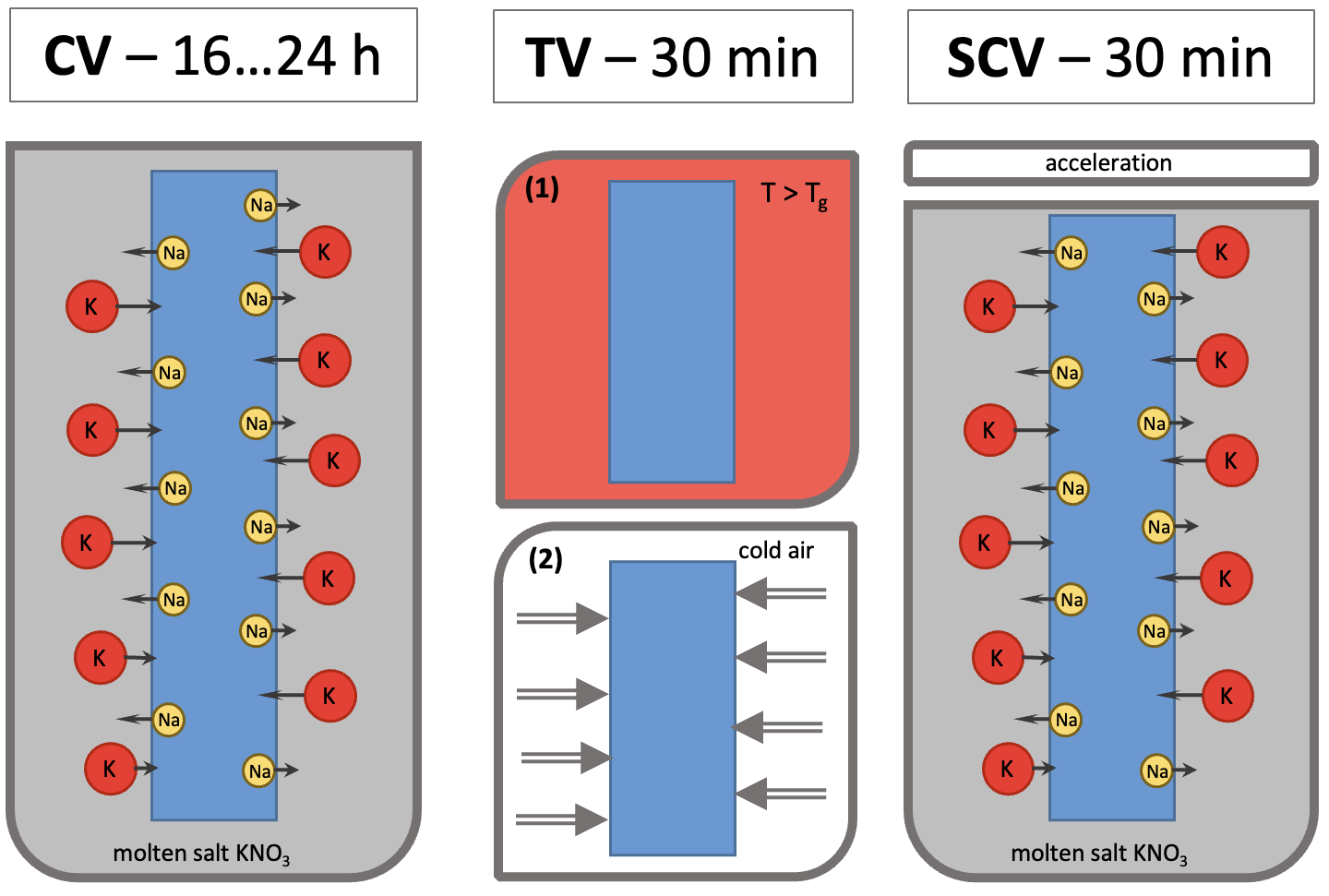
During chemical strengthening, smaller ions in the glass surface are replaced by larger ions from a molten salt bath. This creates a compressive stress layer at the glass surface and increases mechanical resistance.
Four benefits

Fast
Processing times measured in minutes instead of many hours.

Strong
Increased mechanical resistance through chemically generated compressive stress.

Light
Higher strength creates opportunities for thinner and lighter glass products.

Scalable
Short processing times provide the basis for new continuous production concepts.
Applications
- Container Glass
- Flat Glass
- Display Glass
- Pharmaceutical Glass
- Technical Glass
The fast strengthening process provides the technological basis for our new continuous equipment concepts.
Discover Continuous Lines